
Softball guide
Softball Glove Size by Position
Youth softball glove sizing by position — fielding gloves are larger than baseball gloves due to the bigger ball, with position-specific pocket depth and web style guidance.
Best next step
Check the table, then confirm the brand chart.

Photo: Jacob McGowin / Unsplash
Softball gloves are longer and have deeper pockets than baseball gloves because the ball is larger. A baseball glove is not a substitute — the smaller pocket makes catching a 12-inch softball much harder, and the sizing charts do not align. Youth softball gloves typically start around 11 inches for smaller beginners and reach up to 14 inches for outfielders and older players.
Position affects glove size more in softball than many parents expect. Outfielders need extra reach and a deep pocket to secure a fly ball at the warning track. Infielders prefer a shallower, quicker glove for fast transfers from glove to throwing hand. Pitchers generally use a closed-web glove to hide the ball's grip from the batter.
Editorial note
We use these guides as starting ranges, then compare the recommendation against brand charts, fit checks, and sport-specific safety rules before surfacing gear links. Read more about how our sizing works.
Spot a range that looks off, or a league rule we should mention? Tell us — corrections make these guides better for every parent.
Step 1
Find the likely size range
| Player / measurement | Starting size | Notes |
|---|---|---|
| Beginners / ages 5-7 (any position) | 10-11.5 in utility | Flexibility matters more than position fit at this stage. |
| Infield / ages 8-13 | 11.5-13 in | Shorter glove allows faster transfers. I-web or H-web are common. |
| Outfield / ages 8-13 | 12.5-14 in | Deeper pocket for fly ball security. Basket web is popular. |
| Pitcher / ages 8-13 | 12-13 in | Closed web conceals the grip. Smaller glove for quicker reaction. |
| Catcher / ages 8-13 | 32.5-34 in mitt | Catcher mitts are measured in circumference. Different sizing system. |
Step 2
Measure before you shop
Points to measure
Softball glove checkpoints
Softball gloves are larger than baseball gloves. Position determines size more than age — confirm where your child plays first.
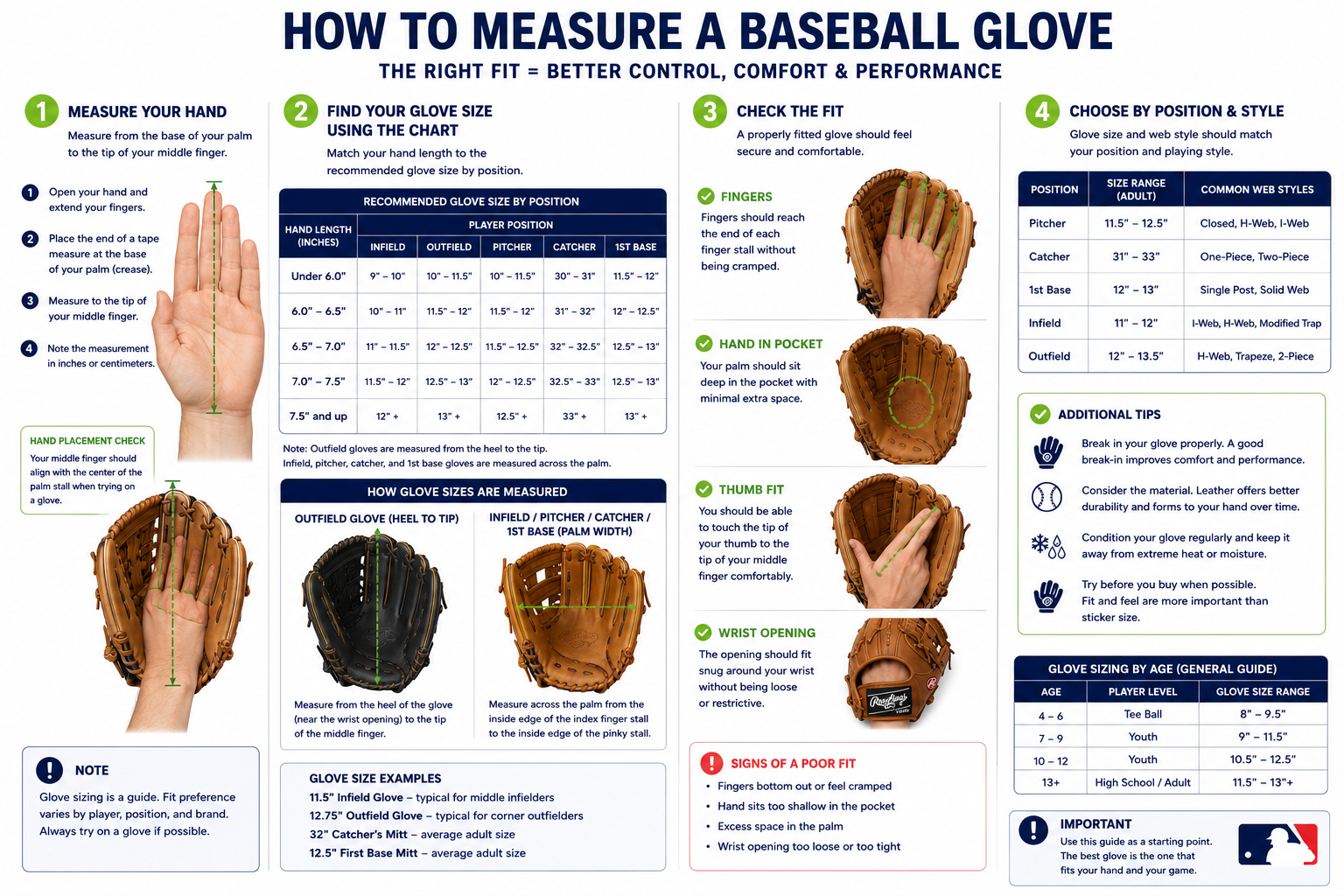
- 1Glove length by positionInfield: 11.5-13 in. Outfield: 12.5-14 in. Catcher: 32.5-34 in mitt.
- 2Pocket depthDeep pocket needed for the larger softball — do not use a baseball glove.
- 3Easy closePlayer should be able to close the pocket with a softball inside.
- 1Measure the hand from the base of the palm (wrist crease) to the tip of the middle finger for a starting size reference.
- 2Position determines glove size more than age — confirm where your child plays before buying.
- 3Try the glove with a regulation softball inside; the hand should be able to close the pocket.
Good reasons
When to size up
- Your child is between sizes and the larger size still feels controlled.
- The season is several months long and the gear is not protective headgear.
- The brand chart says the current measurement is at the top of a range.
Avoid these
Common mistakes
- Buying only for growth and making the gear hard to control.
- Skipping the brand chart because another brand fit last season.
- Ignoring league rules for bats, balls, sticks, and protective equipment.
Parent tip
A glove your child cannot close easily is too large. Try it with a softball inside — they should be able to squeeze the pocket shut with one hand.
FAQ
Is this size guaranteed to fit?
No. Treat it as a good starting point, then check the brand's official size chart before buying.
What should I do when my child is between sizes?
Consider comfort, growth, position, league rules, and whether the gear is protective. Avoid sizing up helmets without a proper chart match.
Related guides
Know your child's starting size before you shop.
Answer 4 quick questions — sport, gear type, age, and height — and get a beginner-safe size range plus what to avoid.