
Snowboarding guide
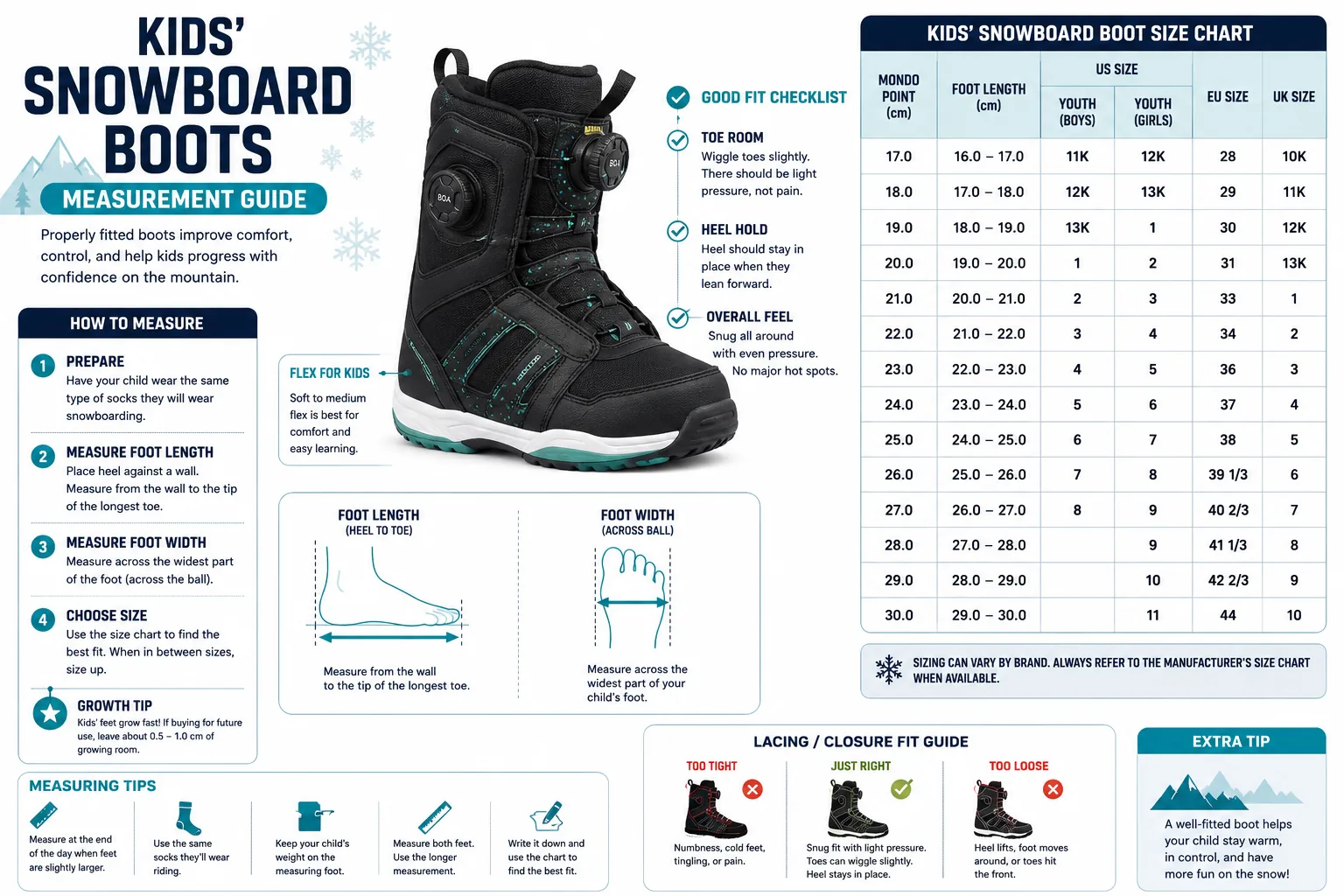
Kids Snowboard Boots Size Chart
How to size youth snowboard boots — street shoe conversion, lace vs BOA systems, and heel lift check before heading to the mountain.
Best next step
Check the table, then confirm the brand chart.

Photo: Unsplash
Snowboard boots differ from ski boots: they are soft-shelled rather than hard, and they size much closer to regular athletic shoes. Most riders size true to street shoe or a half size down. Unlike ski boots, snowboard boots use a standard US shoe sizing system rather than Mondopoint.
The most important fit check is heel lift. With the boot laced or BOA'd snugly, have the child flex their knees and weight onto their toes — the heel should not rise inside the boot. Heel lift makes it nearly impossible to control edge pressure, which translates directly into difficulty learning turns. A boot with heel lift is too large, even if it is the right shoe size.
Editorial note
We use these guides as starting ranges, then compare the recommendation against brand charts, fit checks, and sport-specific safety rules before surfacing gear links. Read more about how our sizing works.
Spot a range that looks off, or a league rule we should mention? Tell us — corrections make these guides better for every parent.
Step 1
Find the likely size range
| Player / measurement | Starting size | Notes |
|---|---|---|
| US shoe 1-3 (approx. ages 5-7) | Youth 1-3 | Limited selection in this range — check kids-specific brands before ordering. |
| US shoe 3-5 (approx. ages 8-10) | Youth 3-5 | Try true to street shoe first. Check for heel lift before buying. |
| US shoe 5-7 (approx. ages 11-13) | Youth 5-7 / Men's 5-6 | Some riders move to adult sizing at US 6. Check both options if between sizes. |
| US shoe 7+ (approx. ages 14+) | Men's 7+ or Women's 8+ | Teen riders often land in adult sizing. Women's sizes run narrower. |
Step 2
Measure before you shop
Points to measure
Snowboard boot fit checkpoints
Snowboard boots fit snugger than street shoes — size true or a half size down.
- 1Heel liftNo heel lift when flexing the boot forward.
- 2Toe contactToes lightly touch the front — not cramped.
- 3Ankle lockBOA or lace should hold the ankle firmly without pressure points.
- 1Start with the child's current street shoe size.
- 2Try the boot on with the thin socks worn on the mountain — not thick hiking socks.
- 3Lace or BOA to a comfortable riding tension and test heel lift by flexing forward with both feet flat on the floor.
Good reasons
When to size up
- Your child is between sizes and the larger size still feels controlled.
- The season is several months long and the gear is not protective headgear.
- The brand chart says the current measurement is at the top of a range.
Avoid these
Common mistakes
- Buying only for growth and making the gear hard to control.
- Skipping the brand chart because another brand fit last season.
- Ignoring league rules for bats, balls, sticks, and protective equipment.
Parent tip
Have your child flex forward in the boot and try to lift their heel. If the heel moves noticeably, the boot is too large. A snug boot is better for learning than a loose one.
FAQ
How do kids' snowboard boot sizes convert to women's sizes?
A common rule of thumb is that a women's size runs about 1 to 1.5 numbers higher than the same youth size — so a youth 6 often lands near a women's 7 to 7.5. But brands differ, so the reliable method is matching foot length in centimeters (Mondopoint), which most boot charts list alongside the US size.
Should kids size up in snowboard boots for growth?
No more than about a half size. Heel lift inside a too-big boot makes turning genuinely harder to learn, and packing out the liner adds room over the season anyway.
Related guides
Know your child's starting size before you shop.
Answer 4 quick questions — sport, gear type, age, and height — and get a beginner-safe size range plus what to avoid.