
Golf guide
Junior Golf Club Size Chart
A parent-friendly junior golf club sizing guide based on height and beginner control.
Best next step
Check the table, then confirm the brand chart.

Photo: Unsplash
Junior golf clubs are sized primarily by height, which makes them different from adult club fitting that also considers wrist-to-floor distance, swing speed, and tempo. For youth players, height is the most practical starting filter because it correlates closely enough with arm length and posture to get the child into a usable range. A club that is too long causes your child to stand too upright, inconsistently choke down on the grip, or develop swing compensations that become harder to fix as they improve.
For beginning juniors, a small starter set with the clubs they will actually use is more useful than a full bag. A beginner can get by with a driver or fairway wood, a mid-iron, a wedge, and a putter. Adding clubs as your child's game develops makes more sense than starting with a 14-club set full of irons they cannot hit yet. Many junior sets are designed around this principle, offering 3-5 clubs for entry-level players.
Editorial note
We use these guides as starting ranges, then compare the recommendation against brand charts, fit checks, and sport-specific safety rules before surfacing gear links. Read more about how our sizing works.
Spot a range that looks off, or a league rule we should mention? Tell us — corrections make these guides better for every parent.
Step 1
Find the likely size range
| Player / measurement | Starting size | Notes |
|---|---|---|
| Under 42 in | Toddler / smallest junior set | Keep clubs light and short. |
| 42-48 in | 39-42 in junior set range | Good early beginner range. |
| 49-54 in | 43-46 in junior set range | Check posture and swing balance. |
| 55-60 in | 47-50 in junior set range | Avoid adult-weight shafts too early. |
| 61+ in | Teen / petite adult transition | Compare junior and adult charts carefully. |
Step 2
Measure before you shop
Points to measure
Junior club checkpoints
Match club length to height, posture, and swing control.
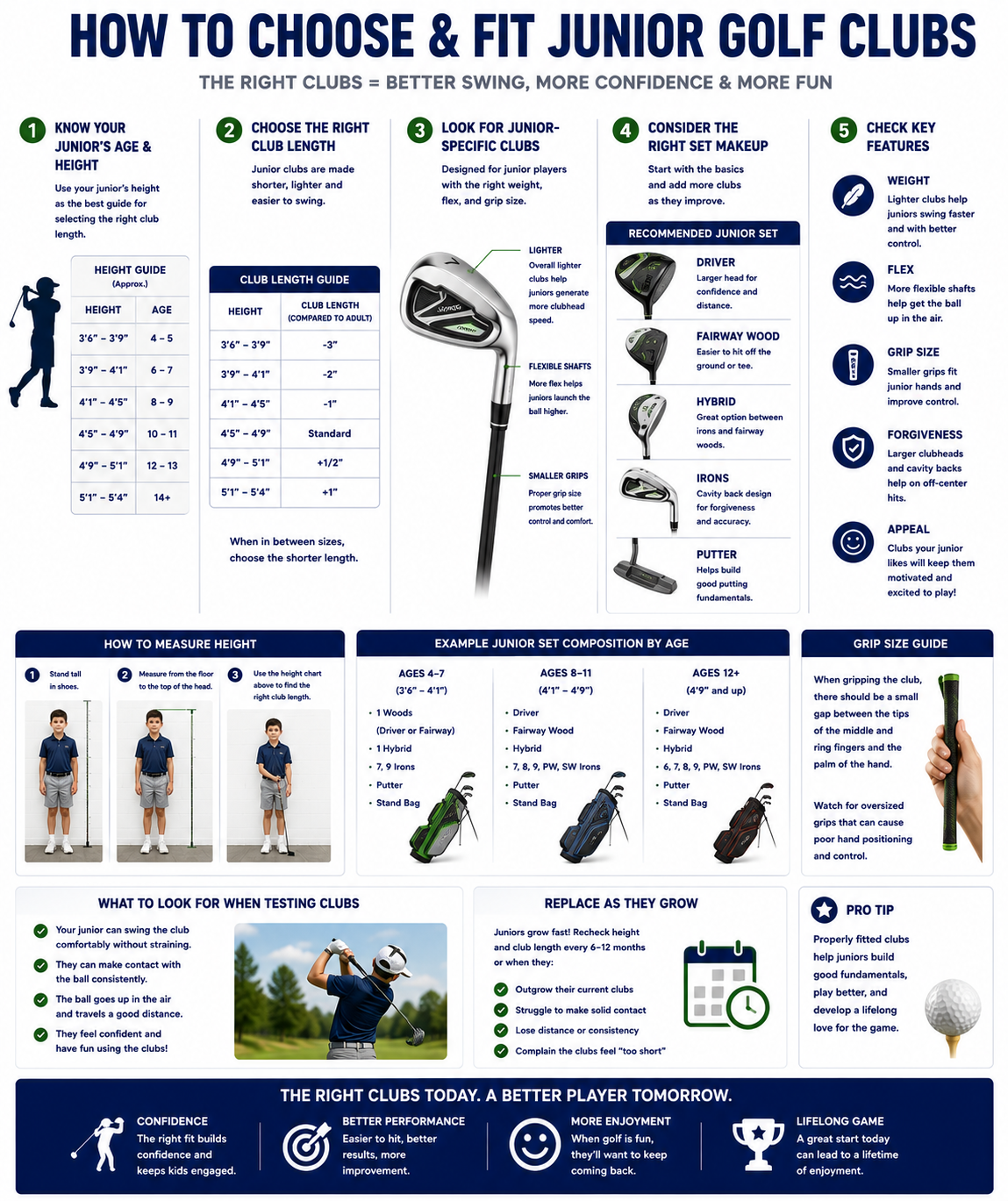
- 1Player heightStart with height in golf or athletic shoes.
- 2Club lengthCompare the set length to brand chart ranges.
- 3PostureChild should stand naturally without reaching.
- 1Measure your child's height in normal golf shoes or athletic shoes.
- 2Have them stand naturally with arms relaxed to check posture with the club.
- 3Compare height to the brand's junior set chart before buying.
Good reasons
When to size up
- Your child is between sizes and the larger size still feels controlled.
- The season is several months long and the gear is not protective headgear.
- The brand chart says the current measurement is at the top of a range.
Avoid these
Common mistakes
- Buying only for growth and making the gear hard to control.
- Skipping the brand chart because another brand fit last season.
- Ignoring league rules for bats, balls, sticks, and protective equipment.
Parent tip
A shorter club your child can swing in balance is usually better than a longer club bought for growth.
FAQ
Is this size guaranteed to fit?
No. Treat it as a good starting point, then check the brand's official size chart before buying.
What should I do when my child is between sizes?
Consider comfort, growth, position, league rules, and whether the gear is protective. Avoid sizing up helmets without a proper chart match.
Related guides
Know your child's starting size before you shop.
Answer 4 quick questions — sport, gear type, age, and height — and get a beginner-safe size range plus what to avoid.