
Baseball guide
Baseball Glove Size by Position
Youth baseball glove sizing by position and beginner needs.
Best next step
Check the table, then confirm the brand chart.

Photo: Keith Johnston / Unsplash
A glove that is too large is one of the most common problems in youth baseball. Parents often buy the biggest glove they can find, assuming their child will grow into it. In practice, a glove that is too big is harder to close, harder to squeeze on a pop fly, and harder to transfer from glove to throwing hand in the infield. For beginners, ease of closing the glove matters more than pocket depth.
Position affects glove sizing once a child starts playing a consistent role. Infielders use smaller, shallower gloves for faster transfers. Outfielders use longer gloves for extended reach. Catchers use a mitt entirely — a different style sized and shaped for blocking and framing, not general fielding. If your child is just starting and does not have a fixed position yet, a versatile middle-infield-style glove is usually the most practical first purchase.
Editorial note
We use these guides as starting ranges, then compare the recommendation against brand charts, fit checks, and sport-specific safety rules before surfacing gear links. Read more about how our sizing works.
Spot a range that looks off, or a league rule we should mention? Tell us — corrections make these guides better for every parent.
Step 1
Find the likely size range
| Player / measurement | Starting size | Notes |
|---|---|---|
| T-ball | 9-10.5 in | Easy close is most important. |
| Infield | 10.5-11.5 in | Quicker transfers. |
| Outfield | 11-12.5 in | More reach and pocket. |
| Catcher | Position mitt | Use catcher-specific sizing. |
Step 2
Measure before you shop
Points to measure
Glove size checkpoints
Glove length runs from the heel of the glove to the top of the index finger.
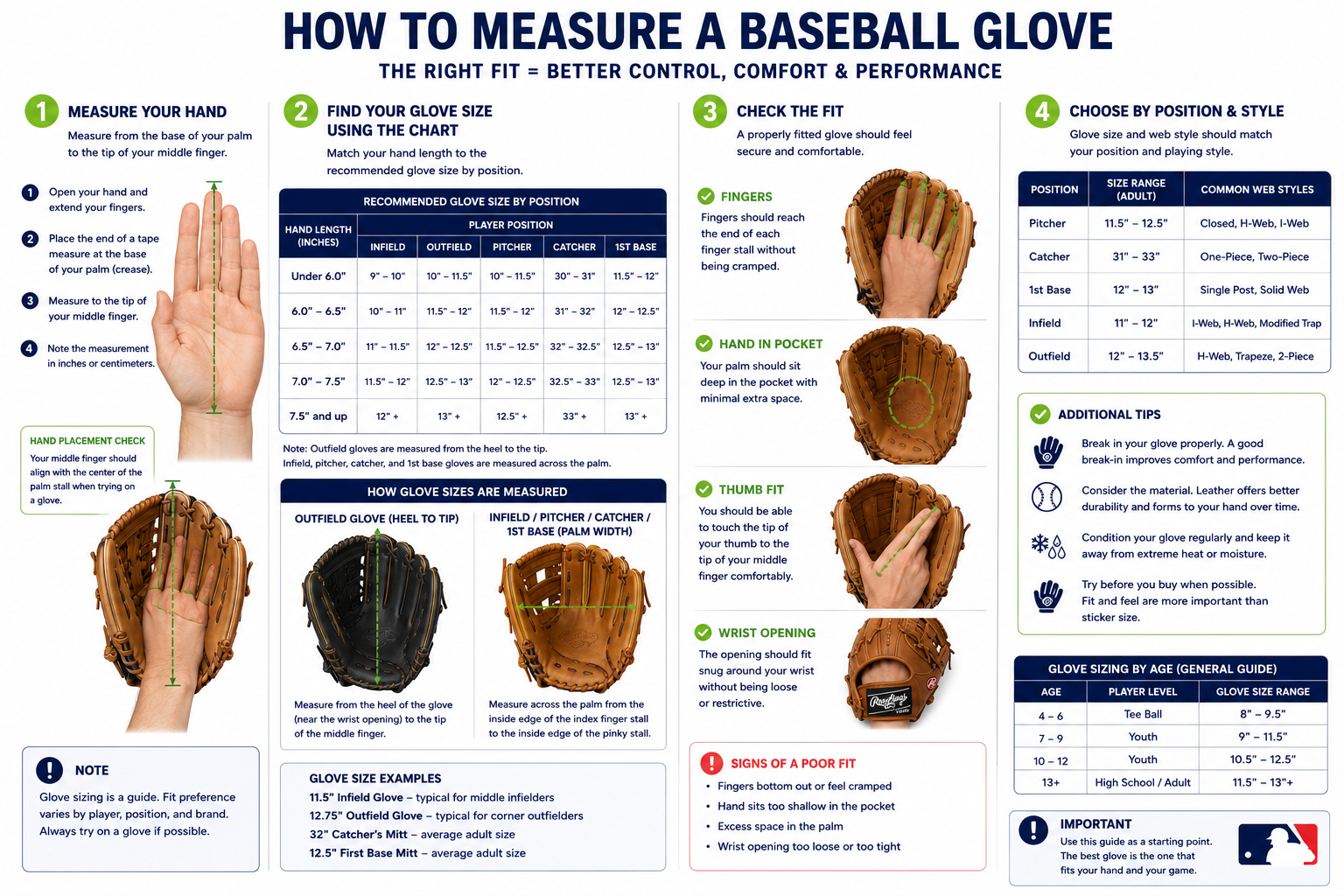
- 1Heel to fingertipUse the glove's stated inch length.
- 2Pocket depthMatch pocket depth to position and age.
- 3Easy closeBeginner gloves should close without a fight.
- 1Measure in socks or the base layer your child will actually wear.
- 2Write down age, height, weight, and any league requirement before shopping.
- 3Compare your measurement to the brand chart and choose the more comfortable beginner-safe range when between sizes.
Good reasons
When to size up
- Your child is between sizes and the larger size still feels controlled.
- The season is several months long and the gear is not protective headgear.
- The brand chart says the current measurement is at the top of a range.
Avoid these
Common mistakes
- Buying only for growth and making the gear hard to control.
- Skipping the brand chart because another brand fit last season.
- Ignoring league rules for bats, balls, sticks, and protective equipment.
Parent tip
For beginners, a glove that closes easily beats a larger glove that looks like it will last longer.
FAQ
Is this size guaranteed to fit?
No. Treat it as a good starting point, then check the brand's official size chart before buying.
What should I do when my child is between sizes?
Consider comfort, growth, position, league rules, and whether the gear is protective. Avoid sizing up helmets without a proper chart match.
Related guides
Know your child's starting size before you shop.
Answer 4 quick questions — sport, gear type, age, and height — and get a beginner-safe size range plus what to avoid.